

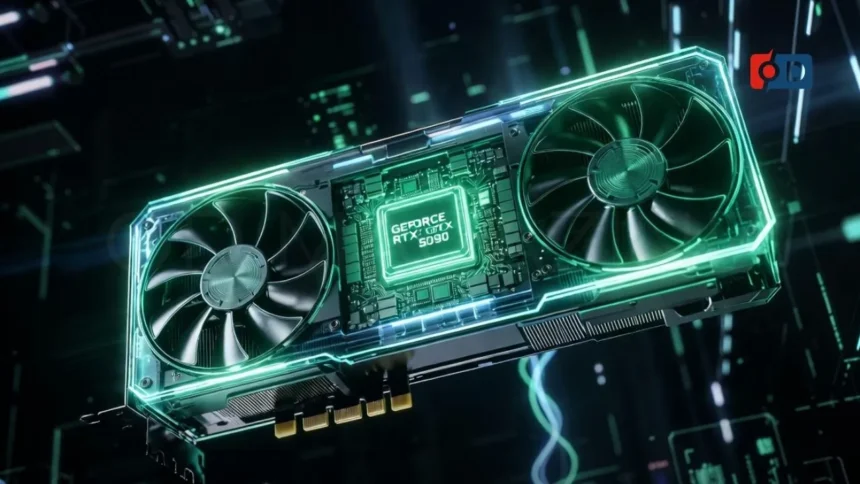
The NVIDIA GeForce RTX 5090 arrived in January 2025 as the flagship of the Blackwell series. It quickly established itself as the most powerful consumer graphics card available in 2026. Gamers, content creators, and AI enthusiasts now turn to it for unmatched performance in 4K and emerging 8K gaming, advanced ray tracing, and demanding workloads.
This guide compiles everything we know about the RTX 5090 in mid-2026. You will find detailed specifications, real-world benchmarks, comparisons with the RTX 4090, new features like DLSS 4 with Multi Frame Generation, power and cooling considerations, pricing trends, and practical advice on whether it makes sense for you. NVIDIA designed the card around the GB202 GPU on a 4nm process, packing 21,760 CUDA cores, 32GB of ultra-fast GDDR7 memory, and groundbreaking AI capabilities that deliver up to 3,352 AI TOPS.
Quick Specs Overview
| Feature | RTX 5090 (Blackwell GB202) | RTX 4090 (Ada Lovelace) |
|---|---|---|
| CUDA Cores | 21,760 | 16,384 |
| VRAM | 32GB GDDR7 | 24GB GDDR6X |
| Memory Bandwidth | 1,792 GB/s | 1,008 GB/s |
| TGP (Total Graphics Power) | 575W | 450W |
| AI Performance (TOPS) | 3,352 | ~1,321 |
| Launch MSRP | $1,999 | $1,599 |
| Release Date | January 30, 2025 | October 2022 |
Blackwell Architecture and Key Innovations
NVIDIA built the RTX 5090 on the Blackwell architecture, which brings major improvements over Ada Lovelace. The GPU features fifth-generation Tensor Cores optimized for neural rendering and fourth-generation RT Cores that handle mega geometry and complex ray-traced scenes more efficiently.
These changes allow the card to process vastly more AI operations per second. Developers gain access to neural shaders that integrate small AI models directly into traditional graphics pipelines. The architecture also includes an AI Management Processor that runs multiple models simultaneously without interfering with gaming performance. In practice, these advancements make the RTX 5090 feel like a significant leap when you enable advanced ray tracing or path tracing in modern titles.
Gaming Performance in 2026
The RTX 5090 delivers strong gains over the previous generation, especially at 4K and with ray tracing enabled. Benchmarks show roughly 30–40% higher frame rates in native 4K compared to the RTX 4090 across many titles. The difference grows larger in heavily ray-traced games like Cyberpunk 2077 with path tracing, where the 5090 often reaches 60–80 FPS with optimized settings while the 4090 struggles closer to 35–50 FPS.
DLSS 4 plays a huge role here. The new transformer-based model improves image quality and upscaling efficiency. Multi Frame Generation can multiply performance further by generating additional frames with minimal added latency. In demanding scenarios, users report smooth 4K gameplay at high refresh rates that felt impossible on the previous flagship. However, raw rasterization gains remain more modest in CPU-bound situations or older games.
DLSS 4 and AI Features
DLSS 4 represents one of the biggest upgrades on the RTX 5090. It introduces Multi Frame Generation, which creates multiple AI-generated frames from a single rendered frame. This technology boosts frame rates dramatically while maintaining responsive gameplay and excellent visual fidelity.
The card also supports advanced ray reconstruction and neural materials that enhance realism in lighting and textures. Creators benefit from faster video encoding with the ninth-generation NVENC and improved decoding. For AI workloads, the 32GB of GDDR7 memory combined with high tensor performance makes the 5090 excellent for local large language model inference, image generation, and video tasks. Many users see 40–60% faster results compared to the RTX 4090 in tools like Stable Diffusion or LLM inference.
Power Consumption and Cooling Requirements
The RTX 5090 draws up to 575W under load, a notable increase from the 4090’s 450W. In real gaming scenarios, power usage often sits between 450–550W depending on the title and settings. This higher demand requires a robust power supply — NVIDIA recommends at least a 1000W unit for safe headroom.
Cooling solutions vary by model. The Founders Edition uses a compact dual-slot design with advanced liquid metal thermal interface material and excellent airflow. It keeps temperatures under 65–70°C in most tests while remaining relatively quiet. Partner cards from ASUS, MSI, and others offer triple-slot or even liquid-cooled options for enthusiasts who want maximum overclocking potential or quieter operation. Proper case airflow becomes essential to avoid thermal throttling.
Pricing and Availability in 2026
NVIDIA launched the RTX 5090 at a $1,999 MSRP for the Founders Edition. In 2026, real-world prices tell a different story. Due to ongoing GDDR7 memory shortages and strong AI-driven demand, many models sell well above $3,000, with premium custom versions reaching $4,000–$5,000 or more in some markets.
Supply remains constrained throughout 2026. NVIDIA continues shipping cards, but stock sells out quickly at major retailers. A rumored higher-end variant (possibly RTX 5090 Ti or Titan Blackwell) may arrive in Q3 2026 with even more cores and higher power limits. Buyers should monitor restocks carefully and consider whether waiting for potential price stabilization makes sense.
RTX 5090 vs RTX 4090: Is the Upgrade Worth It?
The RTX 5090 offers clear advantages in ray tracing, AI-enhanced features, and future-proofing with 32GB VRAM. If you play at 4K with maximum settings and heavy ray tracing, or if you use the GPU for content creation and local AI, the performance jump feels meaningful — often 30–50% or more in optimized scenarios.
However, owners of a well-performing RTX 4090 may not feel an urgent need to upgrade for pure rasterization or 1440p gaming. The extra cost, higher power draw, and current premium pricing make the jump expensive. Consider your monitor resolution, the types of games you play, and whether DLSS 4 features excite you enough to justify the investment.
Who Should Buy the RTX 5090 in 2026?
Enthusiasts chasing the absolute best 4K or emerging 8K experience will appreciate the RTX 5090 most. Content creators working with high-resolution video, 3D rendering, or AI tools benefit from the massive VRAM and tensor performance. Professionals running local LLMs or complex simulations also find strong value here.
Casual gamers or those on 1440p monitors might find better value in lower-tier RTX 50-series cards or even waiting for potential refreshes. Budget-conscious builders should weigh the total system cost, including a high-wattage PSU and good cooling. In 2026, the card excels for users who demand cutting-edge features and can afford the premium.
Potential Drawbacks and Considerations
Higher power consumption means increased electricity costs and heat output over long sessions. The global memory shortage keeps prices elevated and availability limited. Some users report scalper-driven markups that push effective costs far beyond MSRP.
Future-proofing also depends on software support. While DLSS 4 works beautifully now, ongoing driver and game optimizations will determine long-term value. NVIDIA has a strong track record here, but expectations should remain realistic about diminishing returns in less demanding titles.
Conclusion
The NVIDIA GeForce RTX 5090 stands as a technological powerhouse in 2026. It combines raw compute muscle, revolutionary AI features like DLSS 4 with Multi Frame Generation, and generous 32GB GDDR7 memory into one flagship package. The card delivers impressive gains in ray-traced gaming, content creation, and AI workloads, though at a higher power and price point than its predecessor.
Whether the RTX 5090 makes sense for you depends on your resolution, workload, and budget. For those who want the best consumer GPU available today and can manage the power and cost demands, it offers an exciting leap forward. As the year progresses and potential higher-end variants emerge, the RTX 5090 continues to define the upper end of PC graphics performance.
Frequently Asked Questions
What is the official release date of the RTX 5090?
NVIDIA launched the GeForce RTX 5090 on January 30, 2025, alongside the RTX 5080.
How much VRAM does the RTX 5090 have?
It comes equipped with 32GB of GDDR7 memory, a significant upgrade over the 24GB on the RTX 4090.
What is the power consumption of the RTX 5090?
The card has a 575W TGP. Real-world gaming usage typically ranges from 450W to 550W depending on settings and workload.
Is the RTX 5090 worth upgrading from an RTX 4090?
It depends. Users focused on heavy ray tracing, DLSS 4 features, or AI/content creation see meaningful gains. For standard 4K gaming, the jump may not justify the cost for everyone.
How does DLSS 4 improve performance on the RTX 5090?
DLSS 4 with Multi Frame Generation can multiply frame rates significantly while preserving image quality and keeping latency manageable, especially in demanding ray-traced titles.
What PSU do I need for an RTX 5090 build?
NVIDIA recommends at least a 1000W power supply for safe headroom, especially with a high-end CPU and other components.
Stay More Update: OD MAGAZINE